
INSTRUCTIONAL PLAN 0.1
Teachers With Vision
CONSTRUCTIVISM
The 5E Standard Model
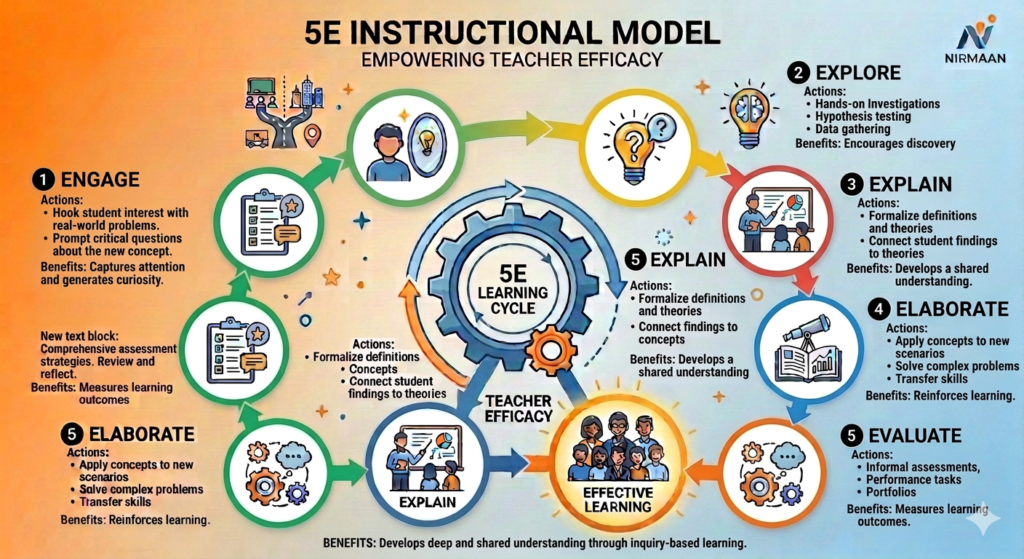
The 5E Standard Model:
- Engage:Connects to prior knowledge and hooks the student’s interest.
- Explore:Provides a common base of experience through hands-on activities.
- Explain:Students verbalize their understanding and the teacher introduces formal definitions.
- Elaborate:Challenges students to apply their knowledge in new, yet similar, situations.
- Evaluate:Encourages students to assess their own understanding and allows teachers to measure progress.
To prepare a lesson plan using the 5E Instructional Model, you’ll follow a circular, student-centered approach where each phase builds on the last.
Based on the NIRMAAN model you provided, here is how you should structure your information:
- ENGAGE (The Hook)
- Goal:Capture attention and connect to prior knowledge.
- Actions:Present a real-world problem, show a mysterious video, or ask a “big” question.
- In your software:Create an input field for the “Hook Activity.”
- EXPLORE (Inquiry)
- Goal:Let students investigate before they are taught the “right” answer.
- Actions:Hands-on experiments, data gathering, or group research.
- In your software:List the materials and specific investigation tasks.
- EXPLAIN (Direct Instruction)
- Goal:Formalize the learning.
- Actions:Students share what they found; the teacher introduces formal terms and theories.
- In your software:Define key concepts and provide the “textbook” explanation.
- ELABORATE (Application)
- Goal:Deepen understanding by applying it to a new situation.
- Actions:Solve a complex problem or transfer the skill to a different context.
- In your software:Create a “Challenge Task” to test if they can use the concept elsewhere.
- EVALUATE (Assessment)
- Goal:Measure learning outcomes.
- Actions:Quizzes, performance tasks, portfolios, or student self-reflection.
- In your software:Include a rubric or a set of exit-ticket questions.
Sample 5E Math Lesson: Introduction to Fractions
- Engage:Share a pizza with 8 people; ask how much each person gets.
- Explore:Give students paper circles to fold and cut into equal parts.
- Explain:Introduce terms like “Numerator” and “Denominator” based on their paper slices.
- Elaborate:Ask how to share the same pizza if 2 more friends arrive.
- Evaluate:A short worksheet where students shade fractions of different shape
Lesson Plan: The Human Heart (Pump of Life)
Subject: Bio-Science | Grade: 8th Std | Duration: 45-60 Mins
- ENGAGE (Hook & Interest)
- Actions:
- Ask students to place two fingers on their neck (carotid pulse) and jump in place for 30 seconds.
- Prompt Question:“Why does that ‘thumping’ get faster when you move? Is your heart a smart machine?”
- Benefits:Captures attention and generates curiosity about heart rate and physical activity.
- EXPLORE (Hands-on Investigation)
- Actions:
- Provide small groups with a 3D heart model or a clear diagram.
- Task:Use red and blue yarn to trace a path through the four chambers.
- Hypothesis Testing:Ask students to predict which side of the heart has thicker walls based on where the blood needs to travel (to the lungs vs. the whole body).
- Benefits:Encourages discovery of the heart’s structure before formal definitions are given.
- EXPLAIN (Formalize & Connect)
- Actions:
- Students share their “yarn paths.”
- Teacher introduces formal terms: Atria, Ventricles, Aorta, and Vena Cava.
- Explain the role of valvesas “one-way doors” to prevent backflow.
- Benefits:Develops a shared understanding by connecting student findings to biological theories.
- ELABORATE (Apply & Transfer)
- Actions:
- Scenario:“What happens to the heart’s flow if a valve doesn’t close properly?”
- Problem Solving:Have students calculate the total blood pumped in one minute if the heart pumps 70ml per beat at 72 beats per minute.
- Benefits:Reinforces learning by applying concepts to health scenarios and mathematical calculations.
- EVALUATE (Measure Outcomes)
- Actions:
- Performance Task:Draw a flow chart showing a single drop of blood traveling from the Right Atrium to the Left Ventricle.
- Informal Assessment:A “3-2-1” exit ticket (3 parts of the heart, 2 functions, 1 question they still have).
- Benefits:Measures learning outcomes and identifies any remaining misconceptions.
How this helps your Software (NIRMAAN):
By following this structure, your B.Ed. student teachers can directly input these Actions into your software’s modules, ensuring they meet the “Teacher Efficacy” goals highlighted in your central graphic.