
CONSTRUCTIVISM 0.3
Teachers With Vision
CONSTRUCTIVISM
CONSTRUCTIVIST THEORIES
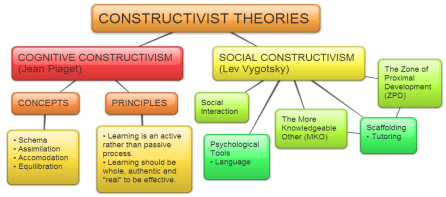
Types of Constructivism
Constructivism is a theory of learning to help the learners to construct something based on their own understanding by assimilating prior knowledge and new ones. According to Kanselaar (2002) there are two major constructivist perspectives. They are Jean Piaget from Swiss and Lev Vygotsky from Russia.
- Cognitive constructivism: Cognitive constructivism is based on the work of Jean Piaget
(1896 -1980), Piaget is a Swiss psychologist who describes knowledge development from a holistic and cognitive perspective, emphasizing that there are many channels that are used to construct understanding e.g reading, listening, exploring, and experiencing .
Cognitive constructivism developed as a reaction to behaviorist and information processing theories of learning . As the reaction to behaviorist, since constructivism tries to help the students as active learners while behaviorism is in opposite. In the information processing, the learner perceives stimuli encodes them into useful information then stores the information for later use while in the constructivism tries to assimilate the previous knowledge and the new one to be the current problem solving. In this case, cognitive constructivism tries to make a situation in which learning as the result of constructing based on individual perspective and his or her previous knowledge.
The development of the human intellectual can be processed through the process of adaptation and organization. Adaptation is a process of assimilation and accommodation. Assimilation occurs in which learners add new knowledge into their existing knowledge framework and accommodation occurs when individuals adjust to new information. In this case, I can infer that assimilation is the way to relate what has already know and prior experience while accommodation to correct the way relating to the new information.
Piaget also organizes scheme to produce the adult mind by using schemata. Schemata or prior knowledge links organize our experience more efficiently for processing. It is important to produce the effective problem solving. Overall, Piaget’s cognitive constructivism focuses on how the individual processes and relates new information to information that already in mind.
Piaget’s theory of cognitive development proposes that children cannot be ‘given’ information that they immediately understand it. Here children must ‘construct’ their own knowledge through experiences. Experiences help to create schemas, schemas changed, enlarged and made more sophisticated through two complimentary processes called assimilation and accommodation. It focuses individual cognitive development through co-constructed learning environment where student develop knowledge individually based on past experiences.
- Social constructivism: Social constructivism is based on the work of Russian psychologist, Lev Vygotsky (1896 – 1934). 2. Lev Vygotsky (1896-1934) Social Cultural Constructivism (socio-constructivist perspective
Vygotsky is a Russian psychologist who introduces the constructivism through socio-constructivist perspective. In this case, the theory of Vygotsky emphasized in the learning based on context through the interaction with others. According to Safery & Duffy (1995) constructing understanding through interaction with others in social environments in whichknowledge is to be applied.
Vygotsky as the expert of constructivism in socio cultural perspectives assumed that the theory came from the theory of language, thought and mediation in social environment. According to Lowenthal & Muth (2008) pure social constructivists believe that learning occurs via construction of meaning in social interaction within cultures and through language. Social constructivism classroom is rooted from Vygotsky’s psychological theory that knowledge is not transferred from teachers to students but constructed in the students’ mind . It means that the social constructivism which rooted from Vygotsky’s perspective can be applied in education field. In this case, the focus of knowledge doesn’t come from teacher to students but how the students can construct by their own selves .The goal is emphasized in collaborative meaning. The role of teacher is as facilitator who monitors the students’ thinking
The social interaction can occur in classroom. The curriculum that is applied in classroom can absorb the interest of the students and then assimilate it with their own cultures.
From the characteristics of social constructivism, it is important to emphasize to the social environments not within the individual’s mind. Moreover, it is also important that the teacher and peers also have the significant role in the application itself. There are four tools for social constructivism. They are scaffolding, cognitive apprenticeship, tutoring, and cooperative learning .
- Scaffolding is the technique to increase the students’ competence and to reduce the teacher’s guidance.
- Cognitive apprenticeship is the technique where the teacher’s belief about the students’ competence to show the best performance and to create the learning situation as well as possible
- Tutoring is the effective technique to help the students’ learning by giving explanation that can be done between an adult and a child or between a more-skilled child and less skilled child.
- Cooperative learning is the learning by discussing something in group based on their own experience.
According to Vygotsky, the construction of knowledge occurs through interaction in the social world. Social constructivism proposes that the development of cognitive forms occurs by means of the dialectical relationship between the individual and the social context. Cultural symbols, tools and values surface in the social processes. Vygotsky’s “The Zone of Proximal Development (ZPD)” is probably his best know concept. ZPD is Vygotsky’s term for the range of tasks. Thus the lower limit of ZPD is the level of problem solving reached by the child working independently. The upper limit of ZPD is the level of additional responsibility the child can accept with the assistance of an able instructor or more capable peer.
- Bruner (Constructivist theory)
In this case, Jerome Bruner, one of the psychologists of constructivism who supports the cognitive constructivism based on Piaget. It means that Bruner also has the same thinking about individual constructivism that it focuses on how the individual process occurs and it relates new information to information already in the mind. The theoretical framework of Bruner is that learning is an active process in which learners construct new ideas or concept based on their current or past knowledge. Moreover, the focus of Jerome Bruner in cognitivist constructivism is in instruction. So, in this case, the role of the instructor should try and encourage students to discover principles by themselves. The instructor and the students should engage in active activities.
There are three principles of instruction from Jerome Brunner(Meyer, 1998)
- Instruction must be concerned with the experience and the contexts that make the students willing and able to learn (readiness).
- Instruction must be structured so that it can be easily grasped by the students(spiral organization)
- Instruction should be designed to facilitate extrapolation or fill in the gaps (going beyond the information given)
Bruner also uses discovery learning in translating cognitive constructivism principles in teaching and learning in the classroom. In this case, the teacher presents examples and the students work with the examples until they discover the interrelationship between the subject structure. Furthermore, Jerome Bruner also emphasizes in the importance of understanding the structure of a subject being studied. Subject structure refers to the fundamental ideas, relationship, or patterns of the fields that connect all of the essential information. According to Bruner, learning will be more meaningful, useful and memorable for students if they focus on understanding the structure of the subject if they focus on understanding the structure of the subject being studied.