
ELABORATE
Teachers With Vision
5E
ELABORATE
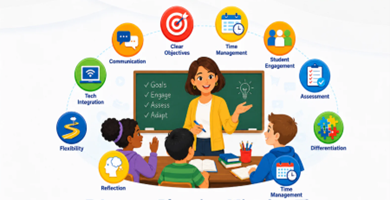
5E Instructional Model, the Elaborate phase (sometimes called the Extend phase) is the “Application” stage. This is where students take the concepts they have just learned and “explained” and apply them to new, related situations.
ELABORATE
Once students have constructed explanations of a phenomenon or design solutions for a problem, it is important to involve them in further experiences that apply, extend, or elaborate the concepts, processes, or skills they are learning. Some students may still have misconceptions, or they may only understand a concept in terms of the exploratory experience. Elaborate activities provide time for students to apply their understanding of concepts and skills. They might apply their understanding to similar phenomena or problemsThe Elaborate phase challenges students to extend their conceptual understanding and practice new skills and behaviors. Its primary goals are to:
- Deepen understandingby applying concepts to a new context.
- Develop broader connectionsbetween the current lesson and other subjects or real-world issues.
- Encourage “Transfer of Learning,”moving knowledge from short-term memory to functional use.
- Types of Elaborate Activities
These activities push students toward higher-order thinking (Bloom’s Taxonomy: Apply, Analyze, Evaluate):
- Problem-Solving Scenarios:Presenting a “What if?” situation that requires the newly learned concept to solve (e.g., if students learned about circuits, they now design a burglar alarm).
- Creative Projects:Developing a model, digital presentation, or “prototype” using your NIRMAAN software to show the concept in action.
- Case Studies:Analyzing a real-world event that mirrors the classroom experiment (e.g., studying a real oil spill after a lab on water density).
- Cross-Curricular Extensions:Connecting a science concept to a social or historical context (e.g., the impact of the Industrial Revolution on the environment).
- Approaches to Elaboration
Teachers use these strategies to ensure students don’t just “repeat” facts:
- The “New Context” Rule:Always provide a situation that is slightly different from the “Explore” phase to test if students truly understand the underlying principle.
- Peer Collaboration:Students work in teams to debate solutions or critique each other’s applications of the concept.
- Scaffolded Independence:The teacher provides less guidance than in the “Explain” phase, allowing students to navigate the new problem more independently.
- Merits and Demerits
Merits (Advantages) | Demerits (Challenges) |
Strengthens Neural Pathways: Applying knowledge to a second scenario makes the memory much more “sticky” and long-lasting. | Highest Time Requirement: This phase often takes the most time and is frequently cut by teachers trying to stay on schedule. |
Builds Confidence: Students feel a sense of mastery when they can solve a new problem without being told exactly how. | Frustration Potential: If the “Explain” phase wasn’t clear, students will struggle significantly here and may become discouraged. |
Real-World Relevance: Shows students why the information matters outside of the classroom or the textbook. | Assessment Difficulty: It can be harder to grade creative or open-ended projects fairly and consistently. |
Encourages Divergent Thinking: Allows for multiple “right” answers or approaches to a single problem. | Resource Gaps: Some students may lack the extra materials or digital literacy needed for complex projects. |
Student Behaviors
- Applies new labels, definitions, explanations, and skills in new, but similar, situations
- Uses previous information to ask questions, propose solutions, make decisions, design experiments, or complete a challenge
- Draws reasonable conclusions from evidence
- Critiques the models, explanations, or arguments made by others using evidence and reasoning
- Makes conceptual connections between new and previous experiences
- Communicates understanding to others
Teaching Strategies
- Expects students to use vocabulary, definitions, and explanations provided previously in new contexts
- Encourages students to apply the concepts and skills in new situations
- Provides additional evidence, explanations, or reasoning
- Reinforces students’ use of scientific terms and descriptions previously introduced
- Asks questions that help students draw reasonable conclusions from evidence and data
- Elaborate :In the fourth stage, Elaborate, students expand on the concepts learned, make connections to other related concepts, and apply their understandings to their world. For example, while exploring light phenomena, a learner constructs an understanding of the path light travels through space. Examining a lamppost, she may notice that the shadow of the post changes its location as the day grows later. This observation can lead to further inquiry as to possible connections between the shadow’s changing location and the changes in direction of the light source, the Sun. Applications to real-world events,
- In the fourth stage, the teacher provides opportunities and guidance for students to apply the constructed knowledge in several real life situations. The students can also correlate the newly constructed knowledge to other related fields of knowledge. These new relationships can further lead to new discoveries or new understandings.
- The tasks that students can perform at this stage are:
- Apply knowledge and skills in real life situations
- Transfer knowledge and skills
- Share information and ideas
- Develop products and promote ideas
- Ask new questions
- ELABORATE on the new concept. Apply the concept in an active learning environment that allows students to elaborate on their
PHASE PURPOSE EXAMPLES 1. ENGAGE • Create interest • Reveal pre-existing ideas and beliefs (preconceptions) • Brainstorming • Concept mapping • Question production • Discrepant events • Demonstrations • Open-ended questions 2. EXPLORE • Explore questions • Prioritise questions • Test student ideas • Group tasks • Investigations • Testing ideas • Research activities 3. EXPLAIN • Compare ideas • Construct explanations and justify them in terms of observations and data • Reporting • Group discussions • Accessing information for concept names and definitions 4. ELABORATE • Apply concepts and explanations in new contexts • Further practical work • Videos • Debates • Research