
INSTRUCTIONAL PLAN
Teachers With Vision
CONSTRUCTIVISM
The 8E Standard Model
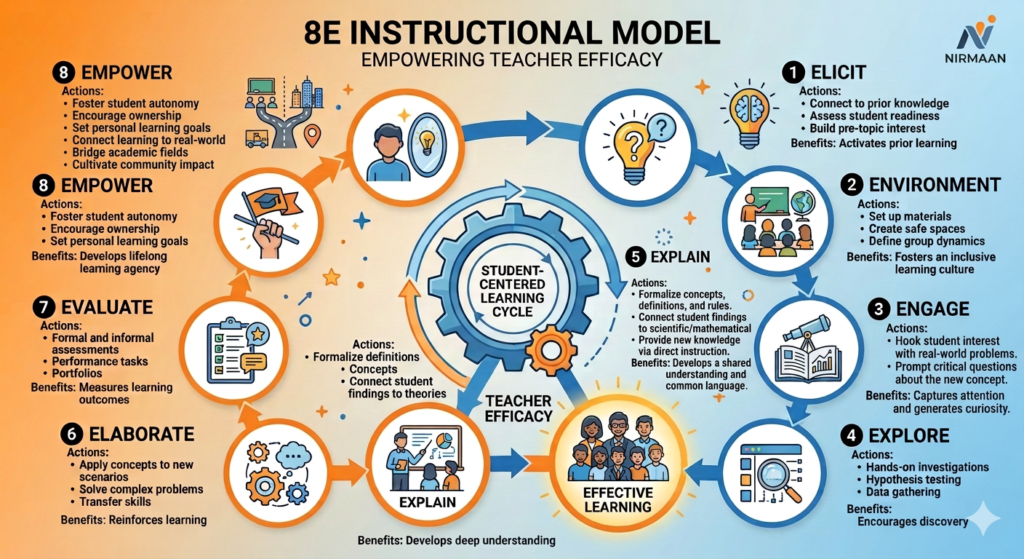
The 8E Lesson Plan model further refines the instructional cycle to ensure maximum student involvement and the practical application of concepts. In the context of modern pedagogy and NEP 2020, it emphasizes the transition from theoretical understanding to innovation and community impact.
8E model provides an even more comprehensive framework for student teachers. This model adds critical stages for pre-assessment and reflection, which are vital for teaching efficacy.
To update your software, you can follow this 8E Instructional Model breakdown:
The 8E Instructional Model Breakdown
Phase | Name | Software Input Goal |
1 | Elicit | Identify prior knowledge/misconceptions before the lesson starts. |
2 | Engage | Create a “hook” to spark interest and curiosity. |
3 | Explore | Hands-on investigation where students lead the learning. |
4 | Explain | Students share findings; teacher clarifies with formal terms. |
5 | Elaborate | Practice the concept in a similar but new context. |
6 | Extend | Apply knowledge to a completely different real-world scenario. |
7 | Evaluate | Use various assessments to check for understanding. |
8 | E-Reflect | (New) Students and teachers look back on how they learned. |
Key Benefits for B.Ed. Student Teachers in NIRMAAN:
- Elicit:It forces the student teacher to plan “Diagnostic Questions” to see if the class is even ready for the topic.
- E-Reflect:This is the most important addition for B.Ed. students. It encourages metacognition, where they analyze their own teaching performance and how students responded.
How to Update your “6” Graphic to “8”
In your software’s visual design, you can keep the interconnected web from your image but add two more “E” nodes. This shows that the phases aren’t just a list, but a network where Reflect and Evaluate touch every other part of the lesson.
The 8 Phases of the Instructional Model
This model is often used in advanced STEM and vocational training to bridge the gap between classroom learning and real-world utility.
- Elicit: Identify what students already know about the topic through diagnostic tools like brainstorming or concept maps.
- Engage: Capture student interest with a “hook”—a real-world problem, a demonstration, or a provocative question.
- Explore: Students investigate the concept hands-on, discovering patterns and data without direct teacher input.
- Explain: Students articulate their findings while the teacher provides formal definitions and clarifies misconceptions.
- Elaborate: Students apply their learning to a similar but new context to deepen their conceptual understanding.
- Extend: (Knowledge Transfer) Students apply the concept to a completely different field or a broader real-world scenario.
- Empower / eNGINEER: (The 8th E) Students use their knowledge to create a tangible solution, prototype, or social initiative. This aligns with NEP’s focus on vocational skills and social impact.
- Evaluate: A holistic assessment of both the learning process and the final outcome (the “Empower” product) through formative and summative rubrics.
Comparison of the E-Models
Model | Focus | Key Addition |
5E | Scientific Inquiry | Basic inquiry cycle (Engage to Evaluate). |
6E | STEM/Design | Adds Engineer for design-based learning. |
7E | Cognitive Depth | Adds Elicit (prior knowledge) and Extend (transfer). |
8E | Innovation/NEP | Adds Empower to focus on community impact and creation. |
Sample 8E Application: “Water Conservation”
- Elicit: Ask students how much water their household uses daily.
- Engage: Show a news clip of a local water crisis.
- Explore: Conduct an experiment on soil water retention.
- Explain: Teach the water cycle and the science of groundwater.
- Elaborate: Calculate the “water footprint” of different common foods.
- Extend: Discuss how water scarcity affects local agriculture and the economy.
- Empower: Have students design and pitch a “Rainwater Harvesting Model” for the school building.
- Evaluate: Assess the viability of their designs and their understanding of the conservation science.
Thank you
Your feedback helps Google improve. See our Privacy Policy.
Share more feedbackReport a problemClose
8 sites
- 8 Instructional Design Models To Use In 2025 – Trupeer.ai
7 Aug 2025 — 5. Gagne’s Nine Events of Instruction * Event 1: Gain attention through compelling openings or scenarios. * Event 2: Inform learne…
Trupeer.ai
- A Comprehensive Guide with 8 Lesson Plan Examples
- Define Clear Objectives. Begin by establishing clear and measurable learning objectives. What do you want your students to achi…
Wondershare
- Block-2: Instructional Design: Theories and Models – eGyanKosh
In this stage, specific feedback should be provided. 8) Assess performance: Here the terminal evaluation/examination of the achiev…
eGyanKosh
- The Phases Of A Lesson Plan | Teaching Wiki – Twinkl
Engage: A learning concept is introduced. Explore: Pupils explore the new concept through learning experiences. Explain: The teach…
www.twinkl.co.za
- Lesson plan – Wikipedia
According to Herbart, there are eight lesson plan phases that are designed to provide “many opportunities for teachers to recogniz…
Wikipedia
- Instructional Models – ERIC
5 May 2019 — * Instructional Models. Doing the Right Things Right. * Instructional Models. Doing the Right Things Right. * Engage. interest. En…
U.S. Department of Education (.gov)
- Implementation of 8E Learning Cycle Model with Instagram to …
31 Dec 2025 — reflecting on learning because the knowledge. formed needs to be more diverse. Instagram is a popular media and can be used. as a …
ResearchGate
- 8 Steps To Lesson Planning | PDF – Scribd
This document outlines an 8-step process for writing effective lesson plans: 1. Define clear, measurable objectives aligned to sta…
Scribd
his is a great way to push your NIRMAAN software to a truly advanced level for B.Ed. student teachers. For 8th Standard History, the 8E model helps move students beyond just memorizing dates to actually thinking like historians.
Here is a model lesson plan on a popular 8th-grade topic: “The Revolt of 1857” (India’s First War of Independence).
8E Lesson Plan: The Revolt of 1857
Subject: History | Grade: 8th Std | Time: 45-60 mins
- Elicit (Prior Knowledge – 5 mins)
- Activity:Show a picture of a British East India Company coin and a local Indian rupee from the 1850s.
- Question:“Who was in charge of India at this time? Was it a King, or a Company? How do you think people felt about that?”
- Goal:Surface what they know about colonial rule before the “explosion” of the revolt.
- Engage (The Hook – 5 mins)
- Activity:Play a 30-second audio clip of a drum roll or a battle sound effect. Show a “Greased Cartridge” (an Enfield rifle bullet).
- Question:“Can a small piece of animal fat change the history of an entire country?”
- Goal:Capture interest through the immediate, controversial cause of the revolt.
- Explore (Investigation – 15 mins)
- Activity:Divide students into small groups. Give each group a different “Source Card”:
- Group A:Economic causes (High taxes on farmers).
- Group B:Social/Religious causes (Westernization).
- Group C:Political causes (Doctrine of Lapse).
- Task:Students must list the “grievances” found in their specific source.
- Explain (Clarification – 10 mins)
- Activity:Groups present their findings.
- Teacher Role:Connect the dots. Use the term “Constructivist” by letting students define the revolt based on their evidence. Introduce key names like Rani Lakshmibai and Mangal Pandey.
- Elaborate (Deepening – 10 mins)
- Activity:Map Work.
- Task:On an outline map of India, students mark the major centers of the revolt (Meerut, Delhi, Kanpur, Lucknow, Jhansi).
- Goal:Understand the geographical spread and why it didn’t cover all of India.
- Extend (Real-World Connection – 10 mins)
- Activity:“The Power of Rumors.”
- Question:“The cartridge issue was a rumor that spread quickly. How do rumors or ‘fake news’ impact big events today?”
- Goal:Connect 1857 communication to modern social media and its consequences.
- Evaluate (Assessment – 5 mins)
- Activity:“Quick-Fire Historian.”
- Task:Write three reasons why the revolt failed despite so much bravery.
- Goal:Assess critical thinking rather than just naming dates.
- E-Reflect (Metacognition – 5 mins)
- Activity:The “Muddiest Point.”
- Task:Ask students to write down: “What part of this story is still confusing to you?”
- Teacher Reflection:For the B.Ed. student, this is where they note if the “Explore” activity was too fast or if students needed more help with the map.