
INSTRUCTIONAL PLAN
Teachers With Vision
CONSTRUCTIVISM
The 7E Standard Model
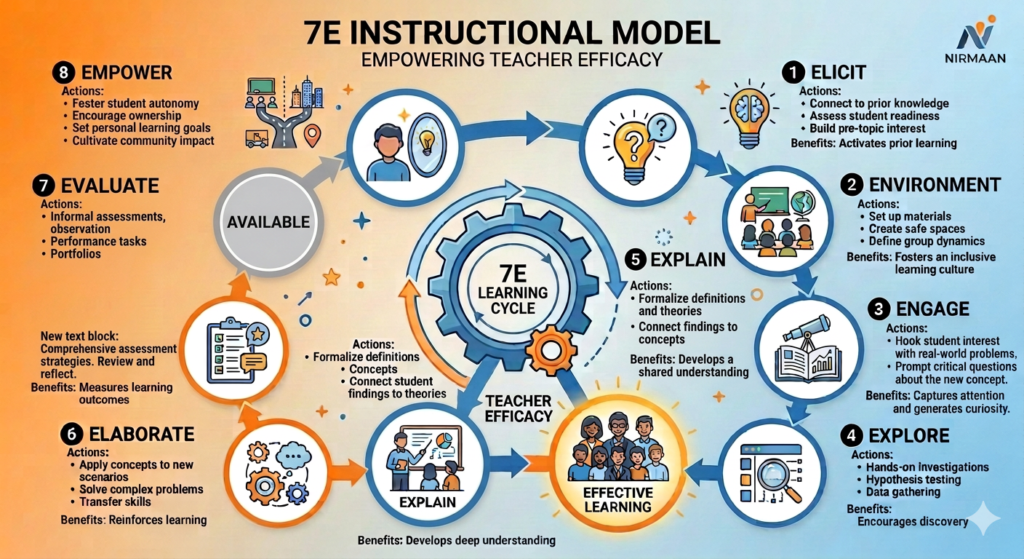
The 7E Instructional Model is an expanded version of the 5E framework, specifically designed to emphasize prior knowledge and the transfer of learning. Developed by Arthur Eisenkraft in 2003, it breaks down the learning cycle into more granular steps to ensure students aren’t just memorizing facts but are constructing deep, transferable understanding.
The 7 Phases of the Model
In an NEP-aligned classroom, these phases ensure that learning is competency-based and integrated.
- Elicit: (New Phase) Before the hook, the teacher explicitly uncovers what students already
- Activity: A quick quiz, KWL chart (Know, Want to know, Learned), or a “Think-Pair-Share” about a previous concept.
- Engage: The “Hook.” This phase grabs student attention and motivates them for the new topic.
- Activity: A surprising video, a “magic” demonstration, or a provocative question.
- Explore: Students participate in hands-on activities to investigate the topic without direct instruction.
- Activity: Group experiments, data collection, or using digital simulations.
- Explain: Students describe what they observed, and the teacher introduces formal terms and scientific concepts to clarify understanding.
- Activity: Peer discussions followed by a brief teacher-led presentation.
- Elaborate: Students apply their new knowledge to a similar context to strengthen their grasp of the concept.
- Activity: Solving a different set of problems or conducting a slightly modified experiment.
- Extend: (New Phase) Students apply the concept to a completely different or real-world situation. This ensures the “transfer of learning” beyond the classroom.
- Activity: A multidisciplinary project or an ITEEA design challenge (e.g., using physics concepts to build a community tool).
- Evaluate: Continuous assessment of student mastery. Under NEP 2020, this focuses on holistic evaluation rather than just marks.
- Activity: Portfolios, self-reflection journals, or performance-based rubrics.
Why use 7E instead of 5E?
- Avoids Overlooking Prior Knowledge: By adding Elicit, you ensure you aren’t teaching something they already know or building on a misunderstanding.
- Promotes Long-term Retention: The Extend phase forces students to generalize the rule, making it harder to forget.
- NEP Alignment: The model perfectly matches the National Education Policy’s push for critical thinking and experiential learning.
This 7E Lesson Plan is designed for Grade 8 Science on the topic of Force and Pressure, strictly following the Arthur Eisenkraft 7E Model and the Indian NEP 2020 guidelines for competency-based learning.
Lesson Metadata
- Subject: Science (Physics)
- Class: VIII (8th)
- Chapter: Force and Pressure
- Duration: 2 Periods (Approx. 80-90 minutes)
- Learning Outcomes (NEP Alignment): Students will be able to define force, differentiate between contact/non-contact forces, and calculate pressure using real-world examples.
The 7E Instructional Cycle
Phase | Activity Description | Teacher/Student Role |
1. Elicit | Ask: “What happens when you kick a ball? Why does a bicycle stop when you hit the brakes?” Students use a KWL Chart (Know, Want to know, Learned). | Teacher: Diagnostician |
2. Engage | The Hook: Try to push an egg into a bottle using air pressure or show a video of a vacuum-sealed tanker collapsing. Ask: “Is air really strong enough to crush metal?” | Teacher: Motivator |
3. Explore | Hands-on Lab: Groups are given magnets, springs, and weights. They test which objects attract without touching (Non-contact) and which require a push/pull (Contact). | Teacher: Facilitator |
4. Explain | Groups present findings. The teacher introduces formal terms: Newton (N) for force, Pascal (Pa) for pressure, and the formula P=F/Acap P equals cap F / cap A 𝑃=𝐹/𝐴 . | Teacher: Concept Builder |
5. Elaborate | Students apply the formula to solve problems: “Why do school bags have wide straps?” or “Why does a sharp needle pierce cloth easier than a blunt one?” | Teacher: Guide |
6. Extend | Real-world Transfer: Research how hydraulic brakes in cars work or how deep-sea divers survive intense water pressure. Connect to Vocational Skills (NEP Goal). | Teacher: Bridge Builder |
7. Evaluate | Formative Assessment: Exit tickets or a digital quiz on Byju’s asking to identify force types in daily scenarios (e.g., a falling apple vs. pedalling). | Teacher: Assessor |
NEP 2020 Integration Features
- Multidisciplinary Link: Connecting Physics to Biology (how muscles apply force) and Geography (atmospheric pressure).
- Assessment: Focus on holistic progress through peer rubrics during the Explore phase rather than just a written test.
- Resources: Use of NCERT textbooks, Scribd lesson guides, and local materials like springs or plastic bottles.
To advance your NIRMAAN software from the 6E model (Engage, Explore, Explain, Elaborate, Extend, Evaluate) shown in your image to a 7E model, you need to add the Elicit phase at the very beginning.
The 7E model focuses even more on the constructivist approach by explicitly drawing out what a student already knows before new information is introduced.
The 7E Instructional Model Breakdown
Phase | Action | Purpose for Student Teachers |
1. Elicit | Activate | Ask “What do you already know?” to uncover prior knowledge and misconceptions. |
2. Engage | Interest | Use a “hook” (video, demo, story) to spark curiosity and focus the mind. |
3. Explore | Experience | Provide hands-on activities where students investigate the concept themselves. |
4. Explain | Communicate | Students share findings; teacher introduces formal terms and definitions. |
5. Elaborate | Apply | Students apply what they’ve learned to a similar, but new, situation. |
6. Extend | Transfer | Students take the concept further into real-world or cross-curricular contexts. |
7. Evaluate | Assess | Both teacher and student check for understanding (formative and summative). |
Key Changes for your Software Update:
- New First Step:Add “Elicit” as the first input field. This helps B.Ed. students plan specific diagnostic questions or pre-assessment tasks.
- Distinction:Ensure the software distinguishes between Elaborate (practicing the same skill) and Extend (applying the skill to a brand new challenge).
- Cyclical Flow:Since your 6E image uses a web/interconnected design, a 7E graphic usually looks like a circle or a spiral, showing that learning is a continuous process.