
5E
5E
ENGAGE
EXPLORE
EXPLAIN
ELABORATE
EVALUATION
Digital Transformation in Education Under the Previewed Blooms Taxonomy:
Blooms Taxonomy as envisaged during conception consisted of knowledge comprehension application analysis synthesis and evaluation which was later transformed to Remember Understand Apply analyze Evaluate create knowledge remains the bedrock for these revised terms. Tools which are available in the digital age can greatly aid in achieving these objectives. Original bloom taxonomy developed in 1956 was revised in 1990 by LORIN ANDERSON.
5E Instructional Model- 1987:
why each phase in the instructional model begins with the letter E?The BSCS Biological Science Curriculum Study ( BSCS ).5E Instructional Model has its origins with the work of earlier science educators, this theory used in learning cycle developed for the Science Curriculum Improvement Study (SCIS). Since the late 1980s, BSCS has used the 5E Instructional Model extensively in the development of new curriculum materials and professional development experiences.
Findings related to the BSCS 5E Instructional Model:
- The 5E Instructional Model is grounded in sound educational theory, has a growing base of research to support its effectiveness, and has had a significant impact on science education.
- The most noticeable void in the literature is research exploring how the 5E approach helps students develop an understanding of the nature of science, and practical and teamwork skills.
- These conclusions indicate the need to conduct further research comparing the effect of the 5E Instructional Model on mastery of subject matter, scientific reasoning, and interest and attitudes with other modes of instruction.
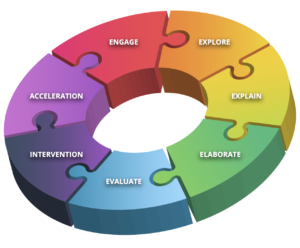
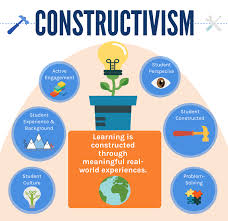
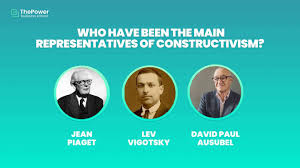
- This model suggests that constructivists lessons should engage students, allow them to explore, aid them in explaining their experience, learning is elaborated, and the lesson includes evaluation.
5E Instructional Model is/does:
- The five phases of the 5E Instructional Model are designed to facilitate the process of conceptual change.
- The use of this model brings coherence to different teaching strategies, provides connections among educational activities, and helps science teachers make decisions about interactions with students.
- Each phase of the model and a short phrase to indicate its purpose from a student perspective are:
DIGITAL MEDIATED E-LESSON PLAN SOFTWARE FOR TEACHER EDUCATION PROGRAMME – J.R.GOLIHALLI. Research Scholar Page 9 |
- Engagement – students’ prior knowledge accessed and interest engaged in the phenomenon
- Exploration – students participate in an activity that facilitates conceptual change
- Explanation – students generate an explanation of the phenomenon
- Elaboration – students’ understanding of the phenomenon challenged and deepened through new experiences
- Evaluation – students assess their understanding of the phenomenon
1.Engage:In the Engage stage, students have their first encounter with the lesson topic. Through questions, thinking, and discussion, students begin to make connections between previous knowledge and the present learning experiences. This process of engagement helps assess current understanding, establishes the organizational groundwork for the lesson ahead, and stimulates student involvement in the anticipation of learning. This is the opportunity to grab the students’ attention and get them excited about what they will be learning. Teachers might ask questions, present a problem, or facilitate some discussion to engage and motivate students.
Stage I – Engage
Facilitating learning environment, learning activities and situations and focusing the minds of learners on the higher order learning tasks is the main purpose of this stage. As far as possible present real life situations to engage student’s attention on learning tasks.
The different ways of engaging learners are:
- Ask open ended questions
- Act out a problematic situation
- Define a problem
- Show a surprising event
- Note unexpected phenomena
- Consider possible responses to questions
- Present situations where student’s perceptions vary.
- In Lesson ENGAGE your students, grab their attention, pique their interest – avoid simply telling
- them what they will do. When you design your engagement
- Consider the objective – How does this apply to real life?
- What is a powerful way to illustrate this to students?
- What can I say as I present to spark their interest- to engage them.
- Write your engagement with your students’ reaction in mind.
LESSON PHASES: ENGAGE
| ENGAGE | EXAMPLES |
|---|---|
| Create interest | Brainstorming |
| Reveal pre-existing ideas and beliefs | Concept mapping |
| Identify preconceptions | Question production |
| Encourage curiosity | Discrepant events |
| Motivate learning | Demonstrations |
| Stimulate thinking | Open-ended questions |
- Explore : In the Exploration stage, the students directly explore the topic of the lesson and related materials. These activities are experiences that ground students in the lesson. Students can work independently, but working in groups allows students to learn from others and build a common understanding of the topic of the lesson. Group work also encourages communication about the topic, which may assist them with sharing what they are learning in subsequent stages. During this stage, the teacher is a facilitator. They provide materials and guidance but allow the students to guide their inquiry. The teacher may ask questions to stimulate students’ thinking or give support, but exploration is about students’ discovery. Direct instruction should be minimal, if at all.
Stage 2 – Explore
In this stage, learners are guided to explore and find answers for the questions/issues raised during the engage stage. Teachers role is to structure and present learning environment which facilitates learners to involve in investigative .
activities and provide opportunities for students to get directly involved with discovery process and construction of knowledge.
Some of the investigative activities can be as follows:
- Provide structured activities
- Have them work in teams
- Experiment with materials
- Use their inquiry to drive the process
- Employee problem solving strategies
- Identify sequence or patterns of events
- Brainstorm possible alternatives
DIGITAL MEDIATED E-LESSON PLAN SOFTWARE FOR TEACHER EDUCATION PROGRAMME – J.R.GOLIHALLI. Research Scholar Page 11 |
According to constructivist approaches, it is very suitable to structure small groups (3 to 6 members) while involving students in the above mentioned activities or any appropriate activity. Cooperative learning strategies are most suitable for this purpose.
In Lesson EXPLORE the new concept through a hands-on introduction that can be an expansion of
your engagement activity. Pose and evoke questions to help students explore and discoverI SAY STATE YOUR OBJECTIVE: Now that you have their attention – How will youcommunicate your objective to your students? Write down the exact words you will use. Youshould include all three parts of your objective, but in language that will engage your students – write this with them in mind.
| EXPLORE | EXAMPLES |
|---|---|
| Explore questions | Prioritise questions |
| Test student ideas | Group tasks |
| Encourage investigation | Investigation |
| Develop understanding | Test ideas |
| Promote inquiry | Research |
- Explain: The third stage, Explain, is the point at which the learner begins to put the experience of the activity into a communicable form. Students may need to articulate the process they used, the sequence of events, their thought processes, and results. Communication may occur within the learner, with peers, or with the teacher. Sometimes even all threeideas, questions, and to articulate their learning.
Stage 3 – Explain At the second stage, students have engaged in the learning activities and through mutual interactions discovered the knowledge (scientific facts, concepts, generalizations and procedures) and constructed. Expressing this abstract knowledge through communicable form is the purpose of the third stage. Students can express the constructed knowledge in different ways as follows:
- Explain the constructed ideas
- Construct and explain a model
- Represent ideas through pictures/figures/graphs
- Represent information through symbols
- Present a summary based on the data
- Present the data through patterns
- Present oral and written reports
- Review and criticize solutions
In Lesson ACTIVE LEARNING BUILDING BLOCKS
- EXPLAIN through Modeling (Reading the story and discussing as youread);
- demonstrate and Show (For the concept of “change”, you may showimages of a baby.
- Child, youth, adult and elderly person.)
| EXPLAIN | EXAMPLES |
|---|---|
| Compare ideas | Reporting |
| Construct explanations | Group discussion |
| Justify ideas using observations and data | Accessing information |
| Develop concept understanding | Concept names |
| Clarify meanings | Definitions |
4.Elaborate :In the fourth stage, Elaborate, students expand on the concepts learned, make connections to other related concepts, and apply their understandings to their world. For example, while exploring light phenomena, a learner constructs an understanding of the path light travels through space. Examining a lamppost, she may notice that the shadow of the post changes its location as the day grows later. This observation can lead to further inquiry as to possible connections between the shadow’s changing location and the changes in direction of the light source, the Sun. Applications to real-world events,
In the fourth stage, the teacher provides opportunities and guidance for students to apply the constructed knowledge in several real life situations. The students can also correlate the newly constructed knowledge to other related fields of knowledge. These new relationships can further lead to new discoveries or new understandings.
The tasks that students can perform at this stage are:
- Apply knowledge and skills in real life situations
- Transfer knowledge and skills
- Share information and ideas
- Develop products and promote ideas
- Ask new questions
ELABORATE on the new concept. Apply the concept in an active learning environment that allows students to elaborate on their understanding.
| ELABORATE | EXAMPLES |
|---|---|
| Apply concepts and explanations | Further practical work |
| Use ideas in new contexts | Videos |
| Extend understanding | Debates |
| Develop deeper learning | Research |
|
5.Evaluate :Evaluate, the final stage, is actually an on-going process of assessing students’ understanding and knowledge of concepts. Assessment can occur at all stages instructional process, but a more formal assessment is typically done to determine whether learning objectives have been met. Evaluation and assessment might be informal, like posing questions for students Evaluation can also be formal, such as a test, report, or prepared presentation. Tools such as rubrics and checklists can be helpful in evaluating outcomes.
At this stage the teacher evaluates whether the students have constructed the knowledge completely and correctly and also have developed conceptual understandings. According to constructivist theory, evaluation should be as far as possible diagnostic in nature.
The tools that are suitable for this purpose are:
- Checklists for observation
- Projects and problem based learning products
- Achievement and attainment tests
- Concept/mind mappings
- Portfolios assessments
- Performance assessments
- Rubrics
- Student interviews
- EVALUATE by continually checking for understanding (informal assessment) by using varied questioning techniques. Reteach if necessary. Assess asnecessary.
| EVALUATE | EXAMPLES |
|---|---|
| Evidence of changes in student’s ideas | Refining concept maps |
| Assess beliefs and understanding | Open-ended questions |
| Evaluate skills and learning | Reflection |
Lesson Planning: 5E Model + Technology:
The lesson planning process is still an excellent opportunity for collaborative planning and development. One popular approach to lesson planning is the 5E Model (Engage, Explore, Explain, Elaborate, and Evaluate). Let’s explore 5E and how it might look when enhanced with technology.
The 5E+T Model Sample Lesson Plan:
The 5Es and a technology connection are shown in the table below,
5E | Technology Connection | What Success Looks Like |
ENGAGE Activities that capture the students’ attention, stimulate their thinking, and help them access prior knowledge. Students become engaged in the process of inquiry. The teacher can ask questions to find out what students already know, or think they know, about the topic and concepts to be covered. These questions typically start with “how” instead of with “why.” | _ Problem-based Learning (PBL) component or Online Simulation _ Collaborative Projects with GoogleApps _ Concept map creation _Milanote Storyboarding Tool _ Create interactive web sites that others can connect and interact with. _ Create video/audio explorations of a topic, responding to questions. | Teacher creates a problem narrative/engagement scenario, video, or resource that engages students, then helps students develop questions and identify what and KWHLT. |
EXPLORE Enable students to explore their ideas, singly and in groups, in classroom or at a distance. Provides students time to think, plan, investigate, and organize collected information. | _ Video _ Blog or Google Sites _ Podcast/Vidcast _ Data collection (Google Form/Sheet) | Students conduct advanced searches using Boolean operators (and/or) after having developed effective questions/search queries, blog journaling, curate content and add comments (e.g. Flipboard), video, vidcast/podcast, remixing another product, create a Google Hangout or Voxer chat. |
EXPLAIN Students acquire opportunities to connect their previous experiences with current learning and to make conceptual sense of the main ideas of the topic being studied. | _ Digital storytelling _ Podcasting/Vidcasting _ Presentation (Google Slides) _ Blog or Google Sites _ Collaborative Product Creation | Create a media product (e.g. video, podcast), digital story or plan a web site using storyboarding and script-writing to share their learning and help others understand it. |
ELABORATE Students apply or extend previously introduced concepts and experiences to new situations. Students apply their knowledge to real world applications. | _ Forum (Google Classroom) _ Product creation _ Virtual field trip _ Ask an Expert video chat | Students develop a solution to a real problem that incorporates their knowledge, communicating that in a variety of media formats. |
EVALUATE Students, with their teachers, review and assess what they have learned and how they have learned it. Students can be given a summative assessment to demonstrate what they know and can do. | _ Video feedback on product _ OneNote notebook with feedback | Students’ creations are notated from a perspective of real life usability rather than teacher satisfaction with a transitional student product. |
The 5E Standard Model:
- Engage:Connects to prior knowledge and hooks the student’s interest.
- Explore:Provides a common base of experience through hands-on activities.
- Explain:Students verbalize their understanding and the teacher introduces formal definitions.
- Elaborate:Challenges students to apply their knowledge in new, yet similar, situations.
- Evaluate:Encourages students to assess their own understanding and allows teachers to measure progress.
To prepare a lesson plan using the 5E Instructional Model, you’ll follow a circular, student-centered approach where each phase builds on the last.
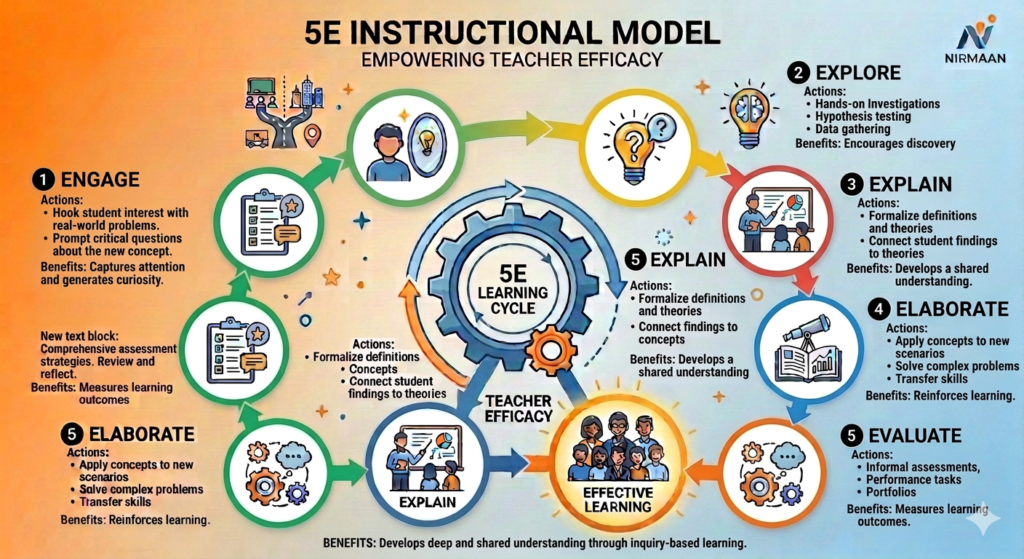
Based on the NIRMAAN model you provided, here is how you should structure your information:
- ENGAGE (The Hook)
- Goal:Capture attention and connect to prior knowledge.
- Actions:Present a real-world problem, show a mysterious video, or ask a “big” question.
- In your software:Create an input field for the “Hook Activity.”
- EXPLORE (Inquiry)
- Goal:Let students investigate before they are taught the “right” answer.
- Actions:Hands-on experiments, data gathering, or group research.
- In your software:List the materials and specific investigation tasks.
- EXPLAIN (Direct Instruction)
- Goal:Formalize the learning.
- Actions:Students share what they found; the teacher introduces formal terms and theories.
- In your software:Define key concepts and provide the “textbook” explanation.
- ELABORATE (Application)
- Goal:Deepen understanding by applying it to a new situation.
- Actions:Solve a complex problem or transfer the skill to a different context.
- In your software:Create a “Challenge Task” to test if they can use the concept elsewhere.
- EVALUATE (Assessment)
- Goal:Measure learning outcomes.
- Actions:Quizzes, performance tasks, portfolios, or student self-reflection.
- In your software:Include a rubric or a set of exit-ticket questions.
Sample 5E Math Lesson: Introduction to Fractions
- Engage:Share a pizza with 8 people; ask how much each person gets.
- Explore:Give students paper circles to fold and cut into equal parts.
- Explain:Introduce terms like “Numerator” and “Denominator” based on their paper slices.
- Elaborate:Ask how to share the same pizza if 2 more friends arrive.
- Evaluate:A short worksheet where students shade fractions of different shape
Lesson Plan: The Human Heart (Pump of Life)
Subject: Bio-Science | Grade: 8th Std | Duration: 45-60 Mins
- ENGAGE (Hook & Interest)
- Actions:
- Ask students to place two fingers on their neck (carotid pulse) and jump in place for 30 seconds.
- Prompt Question:“Why does that ‘thumping’ get faster when you move? Is your heart a smart machine?”
- Benefits:Captures attention and generates curiosity about heart rate and physical activity.
- EXPLORE (Hands-on Investigation)
- Actions:
- Provide small groups with a 3D heart model or a clear diagram.
- Task:Use red and blue yarn to trace a path through the four chambers.
- Hypothesis Testing:Ask students to predict which side of the heart has thicker walls based on where the blood needs to travel (to the lungs vs. the whole body).
- Benefits:Encourages discovery of the heart’s structure before formal definitions are given.
- EXPLAIN (Formalize & Connect)
- Actions:
- Students share their “yarn paths.”
- Teacher introduces formal terms: Atria, Ventricles, Aorta, and Vena Cava.
- Explain the role of valvesas “one-way doors” to prevent backflow.
- Benefits:Develops a shared understanding by connecting student findings to biological theories.
- ELABORATE (Apply & Transfer)
- Actions:
- Scenario:“What happens to the heart’s flow if a valve doesn’t close properly?”
- Problem Solving:Have students calculate the total blood pumped in one minute if the heart pumps 70ml per beat at 72 beats per minute.
- Benefits:Reinforces learning by applying concepts to health scenarios and mathematical calculations.
- EVALUATE (Measure Outcomes)
- Actions:
- Performance Task:Draw a flow chart showing a single drop of blood traveling from the Right Atrium to the Left Ventricle.
- Informal Assessment:A “3-2-1” exit ticket (3 parts of the heart, 2 functions, 1 question they still have).
- Benefits:Measures learning outcomes and identifies any remaining misconceptions.
How this helps your Software (NIRMAAN):
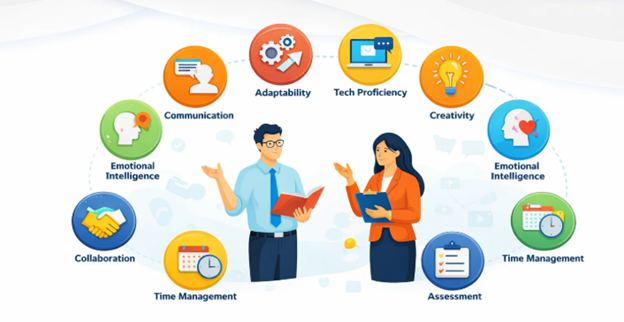
By following this structure, your B.Ed. student teachers can directly input these Actions into your software’s modules, ensuring they meet the “Teacher Efficacy” goals highlighted in your central graphic.
Course Program
Popular Courses
Lorem ipsum dolor sit amet, consectetur adipisicing elit, sed do eiusmod tempor incididunt ut labore et dolore magna aliqua. Ut enim ad minim.