
TPACK
Technological Pedagogical Content Knowledge
1.TPACK HISTORY,
The TPACK (Technological Pedagogical Content Knowledge) framework was developed to explain the complex set of knowledge teachers need to integrate technology effectively into their classrooms.
👤 Founders
The framework was first introduced by Punya Mishra and Matthew J. Koehler, who were researchers at Michigan State University at the time.
📜 Historical Timeline
- Late 1980s (Roots):The framework is a direct extension of Lee Shulman’s (1986) concept of Pedagogical Content Knowledge (PCK), which emphasized the intersection of subject matter and teaching methods.
- Early 2000s (Development):Mishra and Koehler spent five years (approx. 2000–2005) conducting design experiments to study how teachers integrated technology.
- 2006 (Official Launch):The framework was formally introduced in their seminal article, “Technological Pedagogical Content Knowledge: A Framework for Teacher Knowledge,” published in the Teachers College Record.
- 2007–2008 (The Name Change):Originally known as TPCK, the acronym was changed to TPACK (pronounced “tee-pack”) to make it easier to remember and to emphasize that these domains form a “Total PACKage”.
- 2008–2009 (Addition of Context):Recognizing that teaching doesn’t happen in a vacuum, a dotted outer circle representing “Context” was added to the visual model.
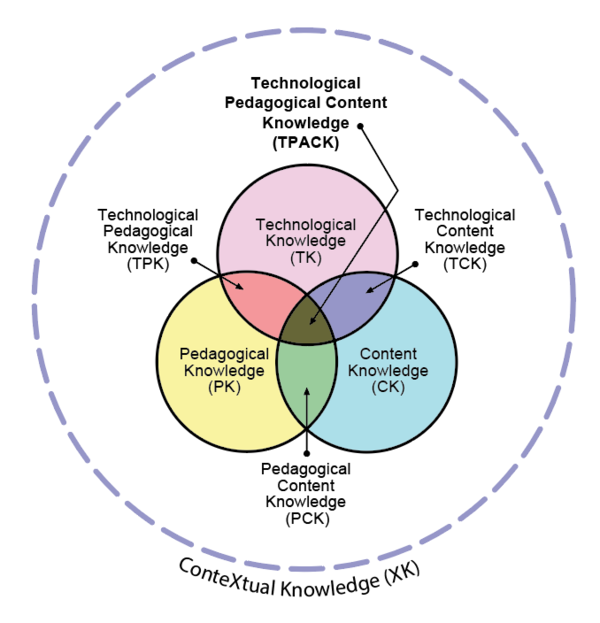
- 2019 (Upgrade to XK):Mishra proposed updating the “Context” circle to Contextual Knowledge (XK), explicitly defining it as a teacher’s awareness of specific organizational and situational constraints (like school policies).
To build a strong foundation on the NIRMAAN software, you should reference the primary origins and the most recent updates of the TPACK framework.
🏛️ Foundational Citations
The TPACK framework is a direct evolution of Lee Shulman’s “PCK” concept, later expanded by Mishra and Koehler to include technology.
- The Original Foundation (PCK):
Shulman, L. S. (1986). Those who understand: Knowledge growth in teaching. Educational Researcher, 15(2), 4–14. - The Launch of TPACK (then called TPCK):
Mishra, P., & Koehler, M. J. (2006). Technological pedagogical content knowledge: A framework for teacher knowledge. Teachers College Record, 108(6), 1017–1054. - The Name Change (TPCK to TPACK):
Thompson, A. D., & Mishra, P. (2007). Breaking news: TPCK becomes TPACK! Journal of Computing in Teacher Education, 24(2), 38.
Evolution & Key Historical Milestones
The history of TPACK is a journey from a static set of knowledge to a dynamic, “Total PACKage.”
Year | Milestone | Signficance for your NIRMAAN Research |
1986 | PCK Introduced | Established that teaching is more than just subject knowledge. |
2006 | TPCK Formalized | Added the “Technology” domain specifically for digital integration. |
2008 | “The Context” Added | Introduced the outer dotted circle, acknowledging school and classroom environments. |
2019 | Upgrade to XK | Mishra renamed “Contexts” to Contextual Knowledge (XK), treating it as a dynamic knowledge domain teachers must possess. |
- Introduction
“The technological pedagogical and content knowledge (TPACK) framework presents a way of thinking about effective technology integration, specifically knowledge associated with integrating technology effectively into learning environments. […] TPACK has the promise to shape the way teacher educators and professional developers prepare teachers to integrate technology (Polly & Mims, in press).” (Polly and Brantley-Dias, 2009:46).
“The basis of good teaching with technology and requir[ing] an understanding of the representation of concepts using technologies; pedagogical techniques that use technologies in constructive ways to teach content; knowledge of what makes concepts difficult or easy to learn and how technology can help redress some of the problems that students face; knowledge of students’ prior knowledge and theories of epistemology; and knowledge of how technologies can be used to built on existing knowledge and to develop new epistemologies or strengthen old ones” (Mishra & Koehler, 2006:1029, cited by Barbour, 2009:56).
The TPACK model emphasizes that successful teachers have content competency (CK) , pedagogical knowledge (PK) and technical skills (TK) and that they are able to relate these forms of knowledge. A good teacher is able to design an aligned, appropriate techno-pedagogical solution for teaching a given content.
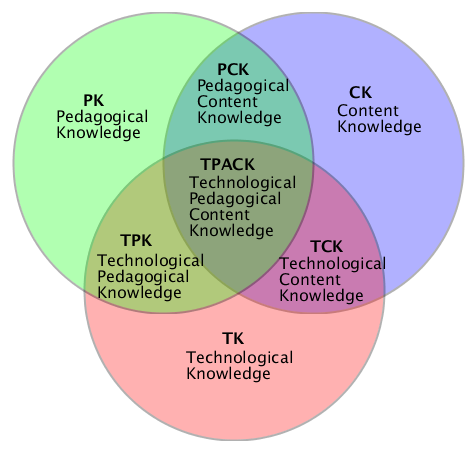
The TPACK model
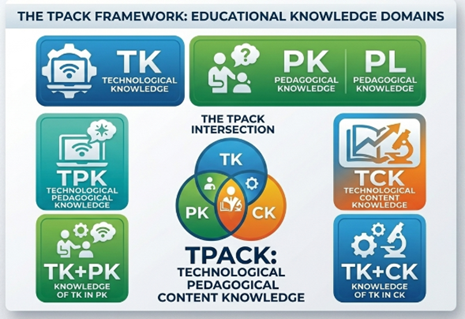
At the heart of the TPACK framework, is the complex interplay of three primary forms of knowledge: Content (CK), Pedagogy (PK), and Technology (TK). The TPACK approach goes beyond seeing these three knowledge bases in isolation. The TPACK framework goes further by emphasizing the kinds of knowledge that lie at the intersections between three primary forms: Pedagogical Content Knowledge (PCK), Technological Content Knowledge (TCK), Technological Pedagogical Knowledge (TPK), and Technological Pedagogical Content Knowledge (TPACK). Effective technology integration for pedagogy around specific subject matter requires developing sensitivity to the dynamic, transactional relationship between these components of knowledge situated in unique contexts.”
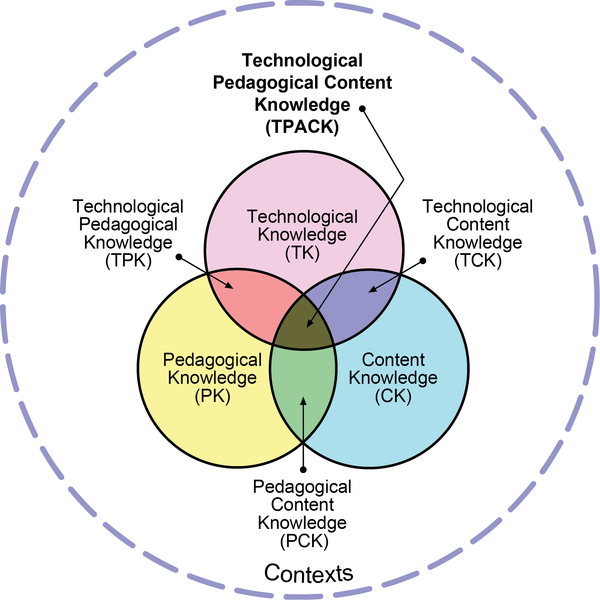
In 2018, Mishra (2019) added the context to the model arguing that conteXtual knowledge (XK) in the outer circle is another knowledge domain that teachers must possess to integrate technology in teaching. “It highlights the organizational and situational constraints that teachers work within. The success of their efforts depends not as much on their knowledge of T, P, C and its overlaps, but rather on their knowledge of the context. This allows us to go beyond seeing teachers as designers of curriculum within their classrooms but rather as intrapreneurs—knowing how their organization functions, and how levers of power and influence can effect sustainable change. This is XK—Contextual Knowledge.”
- In research on the NIRMAANe-lesson plan software, the TPACK (Technological Pedagogical Content Knowledge) framework serves as the theoretical backbone for integrating technology into a constructivist, multidisciplinary environment.
Since your study focuses on B.Ed. student teachers, TPACK is the essential “knowledge set” they must develop to use your software effectively. Below is how TPACK’s core roles align with your research title.
🛠️ The Role of TPACK in Your Research
The TPACK framework (Mishra & Koehler, 2006) goes beyond just knowing how to use software; it is about the synergy between three domains to enhance teaching efficacy.
- Facilitating Constructivist Pedagogy (TPK)
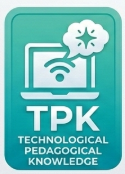
- Role:Technological Pedagogical Knowledge (TPK) helps student teachers understand how NIRMAAN can support student-centered learning.
- Application:Instead of using software for passive presentations, teachers with high TPK use it to create interactive simulations or collaborative digital tasks that align with constructivist principles (e.g., discovery learning or inquiry-based models).
- Supporting Multidisciplinary Content (TCK)
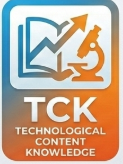
- Role:Technological Content Knowledge (TCK) is the understanding of how technology can represent subject matter in new ways.
- Application:Since your research is “multidisciplinary,” NIRMAAN must allow teachers to bridge different subjects. TCK enables a student teacher to know which digital tools within the software best illustrate a concept (e.g., a 3D model for Science or a GIS map for Geography) across various disciplines.
- Enhancing Teaching Efficacy (TPACK)
- Role:The core intersection (TPACK) is the basis of effective teaching with technology.
- Application:Your research measures the effect of NIRMAAN on teaching efficacy. A teacher’s sense of efficacy increases when they possess a balanced TPACK, as they feel more confident in their ability to troubleshoot technical issues while maintaining high-quality pedagogical standard
The TPACK (Technological Pedagogical Content Knowledge) framework, introduced by Punya Mishra and Matthew J. Koehler in 2006, identifies the specialized knowledge teachers need to effectively integrate technology into their instruction. It builds upon Lee Shulman’s 1986 concept of PCK (Pedagogical Content Knowledge) by adding the dimension of Technology.
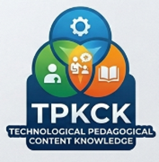
The framework is typically visualized as a Venn diagram with three primary domains and four resulting intersections.
The 3 Primary Domains (The Foundation)
These represent the core knowledge bases educators bring to the classroom:
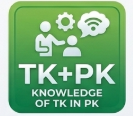
- TK (Technological Knowledge):Knowledge about standard and digital technologies, ranging from basic tools (books, chalkboards) to advanced software, hardware, and the ability to adapt to new offerings.
- PK (Pedagogical Knowledge):Understanding the processes, methods, and practices of teaching and learning. This includes classroom management, lesson planning, and assessment strategies.
- CK (Content Knowledge):Deep understanding of the actual subject matter to be learned or taught (e.g., Mathematics, Science, History), including its central facts, theories, and organizational frameworks.
The 4 Intersections (The Integration)
These represent the “hybrid” knowledge formed when the primary domains interact:
- PCK (Pedagogical Content Knowledge):Knowing which teaching methods are most effective for specific subject matter. It focuses on making content accessible to students through appropriate scaffolding and instructional strategies.
- TCK (Technological Content Knowledge):Understanding how technology and content influence and constrain each other. It involves knowing which specific technologies are best suited for representing particular subject-matter concepts.
- TPK (Technological Pedagogical Knowledge):Knowledge of how various technologies can change teaching and learning experiences by introducing new affordances or constraints. It involves knowing how to deploy tools to support specific pedagogical goals.
- TPACK (Technological Pedagogical Content Knowledge):The “sweet spot” at the center where all three primary areas overlap. It is the complex, situated knowledge
🔵The Outer Circle: Context (XK)
In later versions of the model (around 2008–2009), a dotted outer circle was added to represent Contextual Knowledge (XK). This acknowledges that effective technology integration is not “one size fits all” but depends on situational factors like school policies, student demographics, available resources, and the specific classroom environment.
2.Why TPACK Matters for Your Research
In your study on the NIRMAAN software, TPACK provides the theoretical map to measure how B.Ed. student teachers move beyond just “using a tool” to using it in a way that is pedagogically sound (Constructivist) and content-specific (Multidisciplinary)
In the TPACK framework, there are 7 specific types of knowledge constructs that you can write. These are divided into 3 primary domains and 4 intersections (where the domains overlap).
Additionally, modern versions of the framework include an 8th component representing the classroom environment.
🔴The 3 Primary Domains (Single Types)
These are the individual knowledge bases.
- TK: Technological Knowledge
- PK: Pedagogical Knowledge
- CK: Content Knowledge
🟡 The 4 Intersections (Combined Types)
These occur when two or more primary domains overlap.
- PCK: Pedagogical Content Knowledge (PK + CK)
- TCK: Technological Content Knowledge (TK + CK)
- TPK: Technological Pedagogical Knowledge (TK + PK)
- TPACK: Technological Pedagogical Content Knowledge (TK + PK + CK)
🔵 The 8th Component: Context
- XK (Contextual Knowledge): This represents the outer circle of the framework. It is the teacher’s knowledge of the specific “context” (students, school culture, and available resources) where the teaching happens.
📝 Summary Table for your Writing
When writing your research, you should use these standard abbreviations:
Abbreviation | Full Name | Focus |
TK | Technological Knowledge | Knowledge of tools/software |
PK | Pedagogical Knowledge | Knowledge of teaching methods |
CK | Content Knowledge | Knowledge of the subject matter |
PCK | Pedagogical Content Knowledge | Teaching a specific subject effectively |
TCK | Technological Content Knowledge | Using technology to explain subject concepts |
TPK | Technological Pedagogical Knowledge | How technology changes the way you teach |
TPACK | The Full Framework | Total integration of all three areas |
In your research, NIRMAAN software acts as a “technological catalyst” that influences all seven types of TPACK knowledge for B.Ed. student teachers. By providing a structured, digital environment for lesson planning, it forces them to integrate their subject knowledge with specific digital tools and pedagogical strategies.
Below is how NIRMAAN influences each of the 7 specific types of TPACK:
The 3 Primary Domains
These are the foundational skills the software builds directly.
- TK (Technological Knowledge):Student teachers gain direct experience with the software’s interface, digital tools, and multimedia integration.
- PK (Pedagogical Knowledge):The software’s Constructivist framework (like the 5E or 7E models) reinforces how to design active, student-centered learning experiences.
- CK (Content Knowledge):Through the Multidisciplinary feature, teachers must research and organize deep subject matter across different disciplines to create accurate lesson content.
The 4 Intersections
This is where NIRMAAN truly transforms teaching efficacy by blending the domains.
- PCK (Pedagogical Content Knowledge):NIRMAAN helps teachers decide which constructivist teaching method (PK) is best for a specific multidisciplinary topic (CK).
- TCK (Technological Content Knowledge):The software allows teachers to see how digital tools (TK) can best represent complex concepts (CK), such as using a simulation to explain a scientific process.
- TPK (Technological Pedagogical Knowledge):By using NIRMAAN, teachers learn how the software itself changes their teaching style—for example, moving from a lecture (traditional) to a digital interactive session (modern).
- TPACK (The Full Intersection):This is the ultimate goal. Student teachers use NIRMAAN to create a lesson where technology, pedagogy, and content are perfectly balanced to improve teaching efficacy.
📝 Summary of Influence
TPACK Type | NIRMAAN’s Role |
TK | Proficiency in using the e-lesson software. |
PK | Mastering Constructivist lesson structures. |
CK | Organizing Multidisciplinary subject matter. |
PCK | Matching subject matter with the right teaching strategy. |
TCK | Choosing the right digital representation for a concept. |
TPK | Understanding how the software enables new ways of teaching. |
TPACK | Total Integration for effective digital classroom delivery |
Course Program
Popular Courses
Lorem ipsum dolor sit amet, consectetur adipisicing elit, sed do eiusmod tempor incididunt ut labore et dolore magna aliqua. Ut enim ad minim.