
Instructional Plan
Teachers With Vision
CONSTRUCTIVISM
The 6E Standard Model
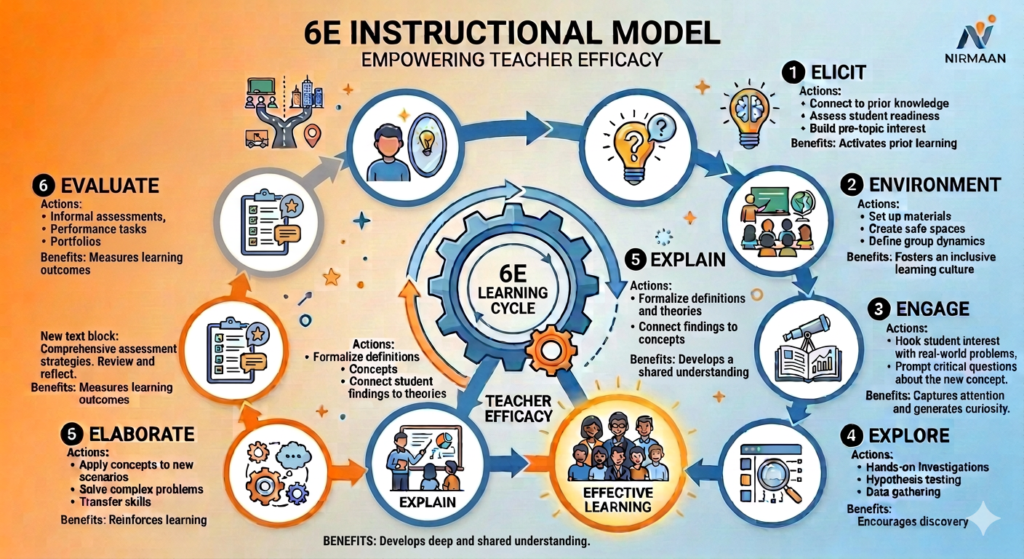
The 6E Instructional Model builds upon the traditional 5E framework by adding a sixth phase to better address specific learning goals, such as engineering design, technology integration, or knowledge transfer.
Depending on the curriculum (e.g., STEM vs. general education), the “6th E” typically refers to one of the following:
- ENGINEER (STEM/Engineering Focus)
Proposed by the International Technology and Engineering Educators Association (ITEEA), this model integrates an engineering mindset into the lesson.
- Phase:eNGINEER
- Role:Students apply their scientific and mathematical understanding to a design challenge. They define problems, develop models, and iterate on solutions to make a tangible difference in the world.
- EXTEND (Application Focus)
Often used in project-based learning, this version emphasizes the transfer of knowledge to broader contexts.
- Phase:EXTEND
- Role:Occurring after Elaborate but before Evaluate, this stage explicitly tasks students with transferring learned concepts to a brand-new, unrelated situation to ensure mastery isn’t limited to a single context.
- E-SEARCH (Technology Focus)
This model, discussed by the National Science Teaching Association (NSTA), focuses on modernizing inquiry through digital tools.
- Phase:E-SEARCH
- Role:Students utilize electronic media (Internet, emails, videos) throughout the cycle to conduct research, communicate with experts, and document their findings visually.
Summary of the 6E Sequence
Phase | Action |
1. Engage | Capture interest and activate prior knowledge. |
2. Explore | Hands-on investigation of the core concept. |
3. Explain | Define terms and formalize student observations. |
4. Elaborate | Deepen understanding through practice in a similar context. |
5. eNGINEER / EXTEND | The 6th E: Apply learning to design solutions or new problems. |
6. Evaluate | Assess mastery and student performance. |
6 E lesson plan phase
The 6E Lesson Plan expands the classic 5E framework to integrate modern educational needs like engineering design, technology, or enhanced knowledge transfer. While multiple versions exist, the most prominent is the 6E Learning byDeSIGN™ model.
The 6E Learning byDeSIGN Model
This version, developed by the International Technology and Engineering Educators Association (ITEEA), is standard in STEM education.
- Engage:Capture interest and pre-assess prior knowledge using a hook or “Big Question”.
- Explore:Hands-on investigation where students work in teams to explore phenomena before formal instruction.
- Explain:Students articulate their findings while the teacher introduces formal vocabulary and clears up misconceptions.
- Engineer:The 6th E. Students apply their new scientific or mathematical knowledge to design and prototype a solution to a real-world problem.
- Enrich (or Elaborate):Students transfer their understanding to more complex and varied contexts to deepen their mastery.
- Evaluate:Ongoing and final assessment of student learning and their design process through rubrics, journals, or portfolios.
Alternate 6E Variations
Depending on your curriculum, the “6th E” might serve a different purpose:
- Extend:Used in project-based learning to explicitly focus on transferring concepts to brand-new, unrelated situations.
- E-Search:Integrates digital literacy by requiring students to use electronic media and research tools throughout the cycle.
- Express:Sometimes used as a phase where students share their work with an authentic audience.
In the context of India’s National Education Policy (NEP) 2020, the 6E Model is an adaptation of the classic inquiry-based framework designed to meet the policy’s specific goals for experiential learning and multidisciplinary integration.
While NEP 2020 officially promotes a “5+3+3+4” structural shift, its pedagogical guidelines often encourage the addition of a sixth “E” to move beyond conceptual understanding into real-world application.
The 6E Phases under NEP 2020
Each phase aligns with the NEP 2020 Focus on developing “higher-order” cognitive skills like critical thinking.
- Engage:Use a “Hook” (storytelling, local context, or a provocative question) to spark curiosity and link the lesson to the student’s existing Indian Knowledge Systems (IKS).
- Explore:Students engage in hands-on, play-based (foundational) or discovery-based (middle/secondary) activities without direct teacher instruction.
- Explain:Teachers facilitate discussions where students articulate their observations. Technical terms and concepts are introduced here to bridge the gap between experience and theory.
- Elaborate:Students apply the concept to a similar situation to solidify their understanding.
- Empower (or eNGINEER):The 6th E. In the NEP framework, this phase focuses on empowering students to use their knowledge for social good or engineering solutions for community-based problems, reflecting the policy’s emphasis on vocational and multidisciplinary skills.
- Evaluate:Assessment shifts from rote testing to formative assessment, focusing on “learning to learn” and competency-based progress.
Core NEP Features Integrated into 6E Plans
- Multidisciplinary Linkages:Every 6E plan should connect the core subject (e.g., Science) to others (e.g., History or Math).
- Life Skills & Values:Phases are designed to foster empathy, teamwork, and constitutional values.
- Digital Integration:The use of technology (ICT) is encouraged throughout the Explore and Empower phases.
Model 6 E lesson plan:
6E Lesson Plan: Area of a Circle
Target Grade: 7th/8th | Time: 60 Minutes
- Engage (5 mins)
- Action:Show a video of a chef tossing pizza dough.
- Question:“If a 12-inch pizza costs and a 16-inch pizza costs , which is the better deal? Is it just about the width, or the space (area) inside?”
- Goal:Spark curiosity about how we measure flat circular space.
- Explore (15 mins)
- Action:Give students paper circles. Have them fold the circle into 16 equal wedges (like pizza slices) and cut them out.
- Activity:Arrange the wedges in a row, alternating points up and down.
- Discovery:The shape looks like a parallelogram. Students measure the “base” (half the circumference) and “height” (the radius).
- Goal:Students “discover” the formula through hands-on manipulation.
- Explain (10 mins)
- Action:Students present their findings.
- Formalization:The teacher connects the “Explore” activity to the formal formula.
- Key Concept:Explain why we use(square units) and how relates to the boundary.
- Goal:Connect the physical activity to the mathematical notation.
- Elaborate (15 mins)
- Action:Practice problems using the formula.
- Task:Calculate the area of different circular objects in the room (clocks, coasters, trash can lids).
- Challenge:“If I double the radius, does the area also double?” (Students calculate to find it actually quadruples).
- Goal:Reinforce the formula through direct application.
- Extend (10 mins)
- Action:Apply the concept to a complex, real-world scenario.
- Problem:“A circular sprinkler rotates degrees and reaches feet. If we change it to only rotate degrees but reach feet, which setting waters more grass?”
- Goal:Transfer knowledge to solve a multi-step, practical problem.
- Evaluate (5 mins)
- Action:Exit Ticket.
- Assessment:“Draw a circle with a diameter of Calculate its area and explain in one sentence how you would find the area if it were a semi-circle.”
- Goal:Assess individual mastery of the lesson objective.