
INSTRUCTIONAL PLAN
Teachers With Vision
CONSTRUCTIVISM
The 9E Standard Model
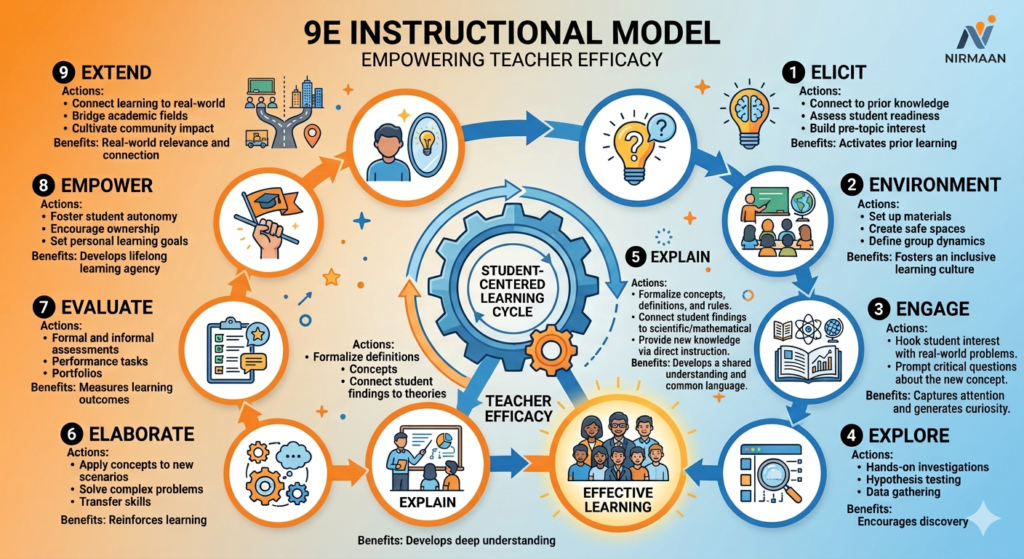
9E Create your study guide Use Canvas to save, plan, and ask anything
Get started The 9E Instructional Model is the most comprehensive extension of the learning cycle, specifically designed for highly collaborative, technology-driven, and socially conscious classrooms. It aligns perfectly with the NEP 2020 vision of creating “Global Citizens” by adding phases for Exchange (collaboration) and Environment (contextual awareness).
To elevate your NIRMAAN software to a 9E Instructional Model, you are moving into the most comprehensive version of constructivist planning. This model is exceptional for B.Ed. student teachers because it integrates pre-planning, emotional intelligence, and long-term mastery.
Here is the breakdown of the 9E Model for your software’s lesson plan preparation:
The 9E Instructional Model Breakdown
Phase | Phase Name | Software Input Goal (What the student teacher writes) |
1 | Elicit | Diagnostic: Identify specific prior knowledge and existing misconceptions. |
2 | Environment | (New) Readiness: Prepare the physical/digital space and emotional tone for learning. |
3 | Engage | Hook: A “discrepant event” or mystery to grab their focus. |
4 | Explore | Inquiry: Hands-on investigation where students struggle productively. |
5 | Explain | Codify: Students present findings; teacher attaches formal terminology. |
6 | Elaborate | Expansion: Apply the concept to a similar context to solidify the “rule.” |
7 | Extend | Transfer: Apply learning to a completely different real-world or multidisciplinary field. |
8 | Evaluate | Assessment: Multi-modal checks (rubrics, quizzes, portfolios). |
9 | Empower | (New) Agency: How students will use this knowledge to take action or help others. |
Why “Environment” and “Empower” matter for NIRMAAN:
- Environment:This forces student teachers to think about classroom management—e.g., “Will students sit in groups? Is the projector ready?”
- Empower:This is the ultimate goal of the Constructivist approach shown in your image. It asks: “Now that the student knows this, what can they do with it to make an impact?”
.
For your NIRMAAN software, moving to a 9E model allows student teachers to plan for every aspect of a Science lesson—from the physical classroom environment to how students will use their knowledge to solve real-world problems.
Here is a 9E Lesson Plan for 8th Standard Science: Light (Reflection and Refraction).
9E Lesson Plan: Light (Reflection & Refraction)
Subject: Science | Grade: 8th Std | Time: 60 mins
- Elicit (Prior Knowledge – 5 mins)
- Activity:Show a picture of a spoon.
- Question:“Why does your face look upside down on one side of a spoon and upright on the other?”
- Goal:Surface existing ideas about curved mirrors and reflections.
- Environment (Readiness – 5 mins)
- Set-up:Darken the room slightly and ensure every group has a flat surface and a clear “ray box” or laser pointer.
- Safety:Discuss laser safety rules (never pointing at eyes).
- Goal:Create a safe, controlled “dark lab” atmosphere for experimentation.
- Engage (The Hook – 5 mins)
- Activity:The “Disappearing Coin” trick. Place a coin under a glass of water and look from the side—it “vanishes.”
- Question:“Did the coin move, or is light playing a trick on our eyes?”
- Goal:Spark curiosity about the bending of light (refraction).
- Explore (Investigation – 15 mins)
- Activity:Give each group a plane mirror, a glass slab, and a protractor.
- Task:Shine a light beam at different angles. Measure the Angle of Incidence and the Angle of Reflection.
- Goal:Students “discover” the law:
- Explain (Codify – 10 mins)
- Activity:Groups draw their ray diagrams on the board.
- Teacher Role:Introduce formal terms like Normal, Lateral Inversion, and Refractive Index. Connect the “coin trick” to the change in speed of light between air and water.
- Elaborate (Expansion – 10 mins)
- Activity:Give students a concave and a convex lens.
- Task:Try to focus sunlight (or a bright lamp) onto a piece of paper. Which lens makes a “dot” (converges) and which spreads light out (diverges)?
- Goal:Apply the laws of reflection/refraction to curved surfaces.
- Extend (Transfer – 10 mins)
- Activity:“The World of Fiber Optics.”
- Question:“How does your high-speed internet travel through a cable? Is it electricity or light?”
- Task:Discuss how Total Internal Reflection allows light to carry data across the ocean.
- Evaluate (Assessment – 5 mins)
- Activity:Ray Diagram Challenge.
- Task:Draw a diagram showing how light travels from a fish in a pond to a human eye standing on the bank.
- Goal:Assess if students can visualize the “bend” at the water’s surface correctly.
- Empower (Agency – Ongoing)
- Activity:“Eye Health & Safety Campaign.”
- Action:Students create a small infographic for the school notice board on how to position computer screens to avoid glare and protect their vision using their knowledge of reflection.
- Goal:Use science to improve the well-being of their community.